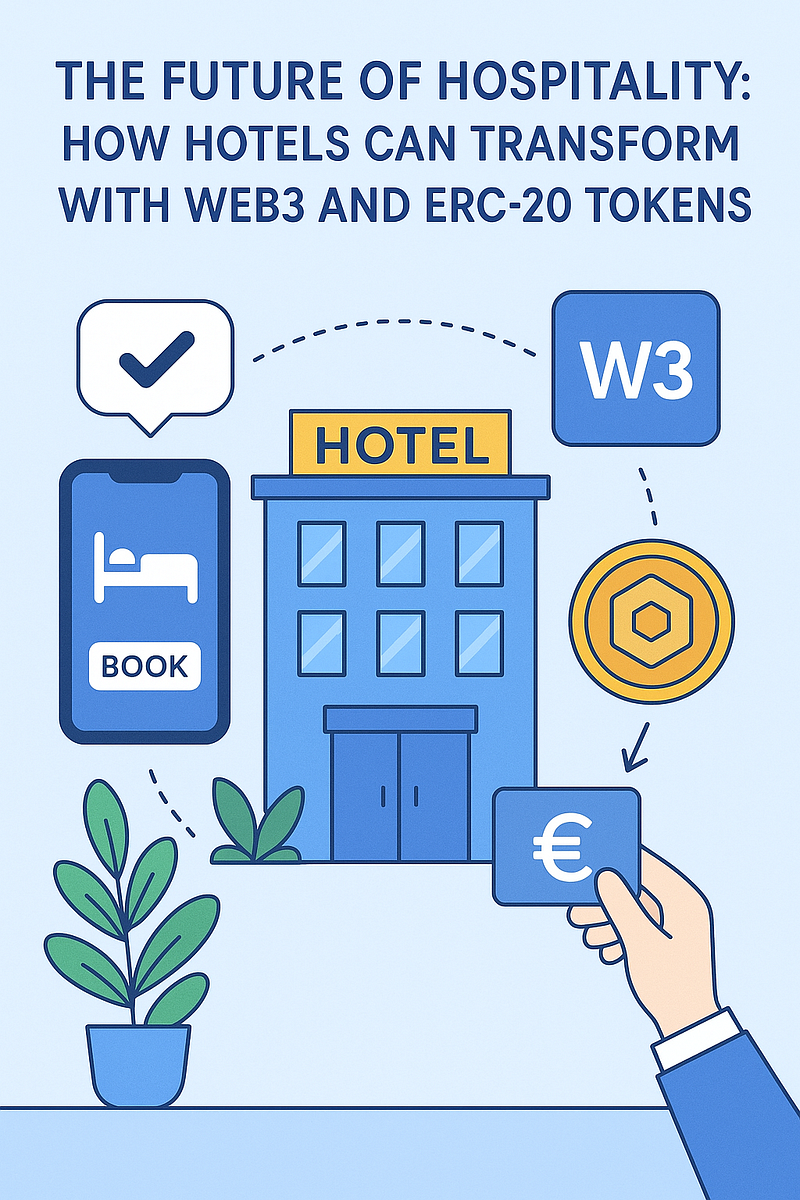
The Future of Hospitality: How Hotels Can Transform with Web3 and ERC-20 Tokens
In an era where digital innovation reshapes every industry, the hospitality sector stands on the brink of a revolution. Blockchain technology, decentralized systems, and tokenized economies are no longer confined to crypto enthusiasts — they are becoming powerful tools for real-world businesses. Hotels, in particular, can leverage Web3 and ERC-20 tokens to create transparent, efficient, and guest-centric ecosystems.
This article explores how a hotel can modernize its operations using a custom ERC-20 token, smart contracts, and blockchain-based systems — complete with a working example.
🔗 Why Web3 for Hotels?
Traditional hotel booking systems rely heavily on centralized platforms like Booking.com or Expedia, which charge high commissions (15–30%). Customer loyalty programs are siloed, hard to redeem, and often expire. Cancellations and refunds are slow and opaque.
Web3 offers a new paradigm:
- Direct guest-hotel relationships
- Transparent, automated rules
- Tokenized rewards and payments
- Decentralized trust without intermediaries
By integrating blockchain, hotels can reduce costs, increase guest loyalty, and build innovative business models.
💡 Introducing “HotelToken” (HTL): A Real-World ERC-20 Example
Let’s imagine “Sunset Resort” launches its own ERC-20 token called HTL. This token powers bookings, rewards loyalty, enables discounts, and even governs future upgrades.
Below is a simplified but functional Solidity smart contract that demonstrates how this works.
✅ Features of the HotelToken (HTL) System:
- Issue a custom ERC-20 token (
HotelToken) - Add rooms with pricing and capacity
- Book rooms with dynamic pricing based on business tier
- Track availability by date
- Enforce cancellation policies automatically
- Classify guests into Bronze, Silver, and Gold tiers based on monthly spending
🧩 Smart Contract: HotelToken.sol
// SPDX-License-Identifier: MITpragma solidity ^0.8.0;
import "@openzeppelin/contracts/token/ERC20/ERC20.sol";
import "@openzeppelin/contracts/access/Ownable.sol";
contract HotelToken is ERC20, Ownable {
  struct Room {
    uint256 id;
    string name;
    string category;
    uint256 basePrice;
  }
  struct Booking {
    uint256 roomId;
    uint256 checkIn;
    uint256 checkOut;
    address guest;
    uint256 paidAmount;
    bool cancelled;
  }
  struct BusinessTier {
    uint256 monthlySpending;
    string tier;
  }
  Room[] public rooms;
  Booking[] public bookings;
  // Room availability: roomID => dayTimestamp => count mapping(uint256 => mapping(uint256 =>
  uint256)) public roomCapacity;
  // Business spending per month (timestamp / 30 days) mapping(address => mapping(uint256 =>
  uint256)) public businessMonthlySpending;
  mapping(address => BusinessTier) public businessTiers;
  // Tier-based pricing (multiplier in %) mapping(string => uint256) public tierMultiplier;
  uint256 public constant DAY = 86400;
  event RoomAdded(uint256 roomId, string name, uint256 capacity, uint256 price);
  event BookingMade(uint256 bookingId, uint256 roomId, uint256 checkIn, uint256 checkOut, address
  guest, uint256 amount);
  event BookingCancelled(uint256 bookingId, uint256 refundAmount);
  event TierUpdated(address business, string tier);
  constructor() ERC20("HotelToken", "HTL") {
    _mint(msg.sender, 1_000_000 * 10**decimals());
    tierMultiplier["Gold"] = 90;
    // 10% off tierMultiplier["Silver"] = 95;
    // 5% off tierMultiplier["Bronze"] = 100;
    // full price
  }
  function addRoom(uint256 id, string memory name, string memory category, uint256 basePrice,
  uint256 capacity) external onlyOwner {
    require(id < 100 && roomCapacity[id][0] == 0, "Invalid or duplicate room ID");
    rooms.push(Room(id, name, category, basePrice));
    uint256 today = block.timestamp / DAY * DAY;
    for (uint256 i = 0;
    i < 365;
    i++) {
      roomCapacity[id][todasy + i * DAY] = capacity;
    }
    emit RoomAdded(id, name, capacity, basePrice);
  }
  function bookRoom(uint256 roomId, uint256 checkIn, uint256 checkOut) external returns (uint256) {
    require(roomId < rooms.length, "Invalid room");
    require(checkIn < checkOut && checkIn >= block.timestamp, "Invalid dates");
    require((checkOut - checkIn) / DAY <= 30, "Max 30 nights");
    uint256 dayStart = checkIn / DAY * DAY;
    uint256 nightCount = (checkOut - dayStart) / DAY;
    for (uint256 day = dayStart;
    day < checkOut;
    day += DAY) {
      require(roomCapacity[roomId][day] > 0, "No availability");
    }
    uint256 pricePerNight = rooms[roomId].basePrice;
    string memory tier = getTier(msg.sender);
    uint256 finalPrice = (pricePerNight * tierMultiplier[tier]) / 100 * nightCount;
    require(transferFrom(msg.sender, address(this), finalPrice), "Payment failed");
    for (uint256 day = dayStart;
    day < checkOut;
    day += DAY) {
      roomCapacity[roomId][day] -= 1;
    }
    uint256 bookingId = bookings.length;
    bookings.push(Booking(roomId, checkIn, checkOut, msg.sender, finalPrice, false));
    uint256 month = checkIn / (30 days);
    businessMonthlySpending[msg.sender][month] += finalPrice;
    updateTier(msg.sender);
    emit BookingMade(bookingId, roomId, checkIn, checkOut, msg.sender, finalPrice);
    return bookingId;
  }
  function cancelBooking(uint256 bookingId) external {
    Booking storage b = bookings[bookingId];
    require(b.guest == msg.sender && !b.cancelled && block.timestamp < b.checkIn, "Cannot cancel");
    uint256 refundPct = block.timestamp < b.checkIn - 48 hours ? 70 : 0;
    uint256 refund = (b.paidAmount * refundPct) / 100;
    if (refund > 0) {
      require(transfer(b.guest, refund), "Refund failed");
    }
    b.cancelled = true;
    for (uint256 day = b.checkIn / DAY * DAY;
    day < b.checkOut;
    day += DAY) {
      roomCapacity[b.roomId][day] += 1;
    }
    emit BookingCancelled(bookingId, refund);
  }
  function updateTier(address guest) public {
    uint256 month = block.timestamp / (30 days);
    uint256 spent = businessMonthlySpending[guest][month];
    string memory tier;
    if (spent >= 5000 * 10**decimals()) tier = "Gold";
    else if (spent >= 2000 * 10**decimals()) tier = "Silver";
    else tier = "Bronze";
    businessTiers[guest].tier = tier;
    businessTiers[guest].monthlySpending = spent;
    emit TierUpdated(guest, tier);
  }
  function getTier(address guest) public view returns (string memory) {
    return bytes(businessTiers[guest].tier).length > 0 ? businessTiers[guest].tier : "Bronze";
  }
}
🏨 How It Works: A Real-World Scenario
- Alice, a frequent traveler, wants to book a room at Sunset Resort.
- She holds HTL tokens (acquired via previous stays or purchase).
- She uses a decentralized app (dApp) to view availability.
- The system checks her tier: she’s “Gold” → gets 10% off.
- She approves the payment and the smart contract:
- Locks payment
- Reduces room availability
- Records her spending
6. If she cancels 3 days before check-in, the contract automatically refunds 70%.
No customer service call. No waiting. No middleman.
🌐 Benefits for Stakeholders
The adoption of Web3 and tokenization in the hospitality industry brings transformative benefits to all stakeholders. Hotels gain greater control over their operations by eliminating reliance on high-commission online travel agencies, significantly reducing costs while fostering direct, transparent relationships with guests. Automation through smart contracts streamlines bookings, cancellations, and payments, improving efficiency and enhancing brand loyalty through innovative token-based incentives. For guests, the experience becomes more transparent and rewarding — pricing is clear, refunds are instant and rule-based, and loyalty rewards are tokenized, permanent, and even transferable. Frequent travelers can enjoy exclusive deals based on their tier, all tracked transparently on the blockchain. Investors benefit from the potential appreciation of the hotel’s native token, especially if the ecosystem grows in usage and adoption. In a decentralized model, they may also gain governance rights, allowing them to vote on key decisions through a DAO, and participate in revenue-sharing mechanisms. Meanwhile, partners such as spas, restaurants, or transportation services can integrate into the ecosystem, accepting the hotel’s token across services — enabling seamless interoperability and creating a broader, more valuable network where loyalty is no longer siloed but shared across experiences. Together, these advantages form a more efficient, fair, and engaging hospitality economy powered by blockchain.
🚧 Challenges & Considerations
While promising, Web3 adoption in hospitality isn’t without hurdles:
- User Onboarding: Most guests don’t have crypto wallets.
- Volatility: Stablecoins (like USDC) may be better than volatile tokens.
- Regulation: KYC/AML compliance for token sales.
- Scalability: Use Layer 2s like Polygon to reduce gas fees.
👉 Solution: Start small — launch a tokenized loyalty program first, then expand to bookings.
🔮 The Bigger Vision: A Decentralized Hotel Network
Imagine a world where:
- Every hotel in a chain issues the same token.
- Guests earn NFT badges for milestones (e.g., “10th Stay”).
- A DAO of guests and staff votes on new amenities.
- Rooms are fractionally owned as NFTs and rented via smart contracts.
This isn’t science fiction — it’s the future of decentralized hospitality.
✅ Conclusion
Web3 is not just about speculation — it’s about rebuilding trust, transparency, and fairness in real industries. With a custom ERC-20 token like HotelToken, hotels can:
- Cut OTA fees
- Automate bookings and refunds
- Reward loyalty permanently
- Empower guests with ownership
The first hotels to embrace this shift won’t just save money — they’ll redefine the guest experience.
🌍 The future of hospitality isn’t just digital. It’s decentralized.