What Happens When You Hire a Junior Who Vibe Codes as a Senior Engineer
On the difference between generating solutions and understanding problems
The Illusion of Seniority
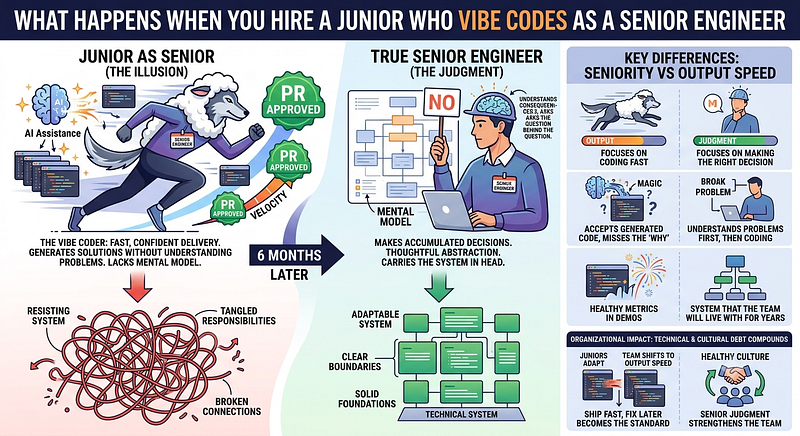
There is a new kind of developer entering the market. They are fast. Impressively fast. They can scaffold a full authentication system in an afternoon, wire up a payment integration before lunch, and push a working feature before the senior engineer has finished reading the ticket. Their PRs are large, confident, and frequent. In a sprint demo, they look like the most productive person in the room.
Then, six months later, the system starts to resist change.
New features take longer than they should. Simple modifications cause unexpected breakage in unrelated parts of the codebase. The architecture review reveals a tangle of responsibilities that nobody can fully explain. The team starts spending more time understanding existing code than writing new code. Nobody can point to a single decision that caused this. It accumulated.
This is what happens when you put a skilled vibe coder in a senior engineering seat.
What Vibe Coding Actually Is
Vibe coding is not a pejorative. It describes a real and legitimate mode of working: iterating rapidly with AI assistance, accepting generated output that works without deeply understanding why it works, and moving forward on momentum rather than comprehension.
In the right context — prototyping, exploration, throwaway scripts, solo projects with a short lifespan — it is genuinely productive. The feedback loop is tight. You describe intent, you get working code, you ship.
The skill involved is real. Prompting effectively, recognizing when output is wrong, composing generated pieces into something coherent — these take practice and intuition. A skilled vibe coder is not simply accepting whatever the model produces. They are curating it. The code works. Tests pass. Demos succeed.
The limitation is not in the output quality of any individual piece. It is in what the process does not build: a mental model of the system.
What a Senior Engineer Actually Does
This is the part most job descriptions get wrong.
A senior engineer’s primary value is not writing more code or writing it faster. It is making decisions that the system will have to live with for years, and understanding the consequences of those decisions before they are made.
This means:
Recognizing the shape of a problem before reaching for a solution. When a requirement arrives, a senior engineer’s first instinct is not “how do I build this” but “what is this really asking, what are the edge cases, and what does this imply about the system’s future direction?” The question behind the question matters more than the question itself.
Understanding why code is organized the way it is. Not just what a module does, but why the boundary is drawn there. What would break if it moved. What assumption the current structure encodes. This is knowledge that cannot be generated — it must be accumulated through reading, reasoning, and sometimes breaking things.
Carrying the system in their head. A senior engineer can close their laptop and still reason about how a change in one part of the system ripples through others. They have a mental model that is not dependent on reading the code in the moment. This model is what makes architectural conversations possible. Without it, every discussion requires reopening files.
Saying no with justification. This is perhaps the most undervalued skill. Knowing which features to push back on, which shortcuts will compound into structural debt, which “quick fixes” will become permanent fixtures — and being able to explain why, clearly, to non-technical stakeholders.
None of these skills are developed by producing output quickly. They are developed by sitting with hard problems long enough to understand them.
The Specific Failure Mode
When a skilled vibe coder operates as a senior engineer, the failure is not visible in the short term. The code ships. Features are delivered. Velocity metrics look healthy. The problems emerge in the second and third order.
Decisions without models
Every non-trivial codebase is a set of accumulated decisions. Where is the boundary between modules? What does this abstraction hide? Why is this data structured this way?
A vibe coder makes these decisions too — but without a stable mental model to anchor them to. The decisions are made by whatever the AI generates combined with whatever makes the current feature work. They are locally coherent but globally inconsistent.
The result is a codebase where different parts of the system solve the same problem in different ways. Not because of deliberate tradeoffs but because each solution was generated independently, optimized for the task at hand, without reference to the whole. The codebase looks like it was written by five different teams who never spoke to each other — because, in a sense, it was.
Abstraction without intention
AI-generated code is full of abstractions. Helper functions, wrapper classes, utility modules. They look like good engineering. They often make the immediate code cleaner.
But abstractions have a hidden cost: they encode assumptions. A well-designed abstraction encodes the right assumptions — the ones that will hold true as the system grows. A generated abstraction encodes whatever assumptions made the current use case work.
When the system evolves, the generated abstractions fight back. They were not designed for extensibility. They were designed to solve one problem. Extending them requires either bending the abstraction past its intended shape or working around it — and working around abstractions creates exactly the kind of parallel, inconsistent structure described above.
A senior engineer knows when to abstract and when to repeat. They know that premature abstraction is as harmful as none at all. This judgment cannot be generated. It comes from having lived with both mistakes.
The naming problem
This is a small thing that reveals a large thing.
Names in code are compressed decisions. A good name encodes what something is, what it is responsible for, and implicitly what it is not. When you read ProposalRevision you know it represents a historical record of a proposal at a point in time. When you read LeadVersion you know nothing without reading the implementation.
Vibe-coded systems tend to have names that describe implementation rather than intent. Tables named after their structure. Functions named after their mechanics. Variables named after their type. This is not laziness — it is the natural output of a process that generates solutions without first articulating the domain.
The naming problem compounds. When new code is added to a system with poor names, the new code inherits the confusion. Developers working in the system adapt to the local vocabulary and lose the ability to see that the vocabulary itself is wrong. Refactoring names feels cosmetic. It is not. Names are the interface between the code and every future developer’s mental model.
Reviews without resistance
Senior engineers are responsible for code review. This is where a vibe coder placed in a senior seat becomes structurally dangerous.
Code review done well is not about finding bugs. It is about asking whether a change makes the system better or worse in ways that are not immediately visible. Does this new module respect the existing boundaries? Does this abstraction encode the right assumptions? Is this the right place to add this behavior? Could this work differently in two years and does this code accommodate that?
These questions require having an opinion about where the system should go — a vision, however informal, of what good looks like. Without a mental model of the system and experience reasoning about systems in general, code review collapses into syntax checking. PRs get approved because the code works, not because it fits.
And the system drifts.
Why Organizations Miss This
The evaluation processes most engineering organizations use are optimized for detecting the wrong failure mode.
Technical interviews test whether a candidate can solve algorithmic problems under pressure. A skilled vibe coder does well here — they have seen many patterns, they can write code that works, and they are comfortable producing output on demand.
Trial periods and probationary work measure feature delivery. A vibe coder excels. They are fast. They unblock themselves without asking many questions. They seem independent.
References measure interpersonal qualities and general performance. Hard to fake.
What organizations almost never evaluate: how a candidate reasons about a system they did not build. Can they read an unfamiliar codebase and form an accurate mental model of it? Can they articulate what is wrong with an existing design and why? Can they make a decision with incomplete information and explain the tradeoffs?
These are the skills that matter at the senior level. They are almost never tested.
The Compounding Problem
Individual contributors influence teams. A senior engineer who vibe codes sets a standard.
Junior and mid-level engineers on the team observe what gets rewarded. They see fast feature delivery praised in sprint demos. They see large PRs merged without deep structural questions. They adapt. The team’s working norms shift toward output speed and away from design quality.
This is not cynicism. It is how organizational culture works. People optimize for what is measured and modeled. If the most visible senior engineer on the team demonstrates that “ship fast, fix later” is the path to success, the team will ship fast and fix later.
The team becomes harder to change not because any individual is resistant but because the accumulated structure of the codebase and the accumulated habits of the team both resist thoughtful change. Technical debt and cultural debt compound together.
What the Job Title Actually Requires
Seniority in software engineering is not a measure of output speed. It is a measure of judgment under uncertainty about consequences that are not yet visible.
A senior engineer does not need to be the fastest coder. They need to be the person who slows down at the right moment — who asks the question that prevents the six-month headache, who pushes back on the feature that would work today but break the architecture next quarter, who names the abstraction correctly the first time so nobody has to rename it later.
These capabilities are built from exposure to failure. From having shipped the quick solution and watched it become the thing nobody wants to touch. From having inherited a codebase with poor boundaries and spent weeks untangling it. From having made a naming decision in month one that the team regretted in year two.
You cannot vibe code your way to that experience. You cannot generate it. You accumulate it by being wrong and understanding why, repeatedly, over time.
The Honest Assessment
Vibe coding is a tool. Like all tools, it is powerful in the right hands for the right job.
In the hands of a senior engineer with deep mental models of systems and software design — someone who knows when the generated output is wrong and why, who uses AI acceleration on implementation details while maintaining personal ownership of design decisions — it is genuinely productive.
In the hands of someone who has optimized for output speed without building the underlying judgment — someone for whom the AI is not a tool but the primary source of design decisions — it produces systems that work until they don’t.
The tragedy is not that vibe coders are incompetent. Many are highly capable in ways that matter and will matter more as the industry evolves. The tragedy is the mismatch: placing them in a role whose primary value is judgment, and then measuring them on output, ensures that the judgment never gets exercised and the output eventually costs more than it delivered.
Hire them for what they are good at. Build the conditions for them to develop the judgment they are missing. Do not hand them the architectural decisions of a system that will outlive the feature they are building.
The system will remember what they decided. Long after the sprint demo is forgotten.