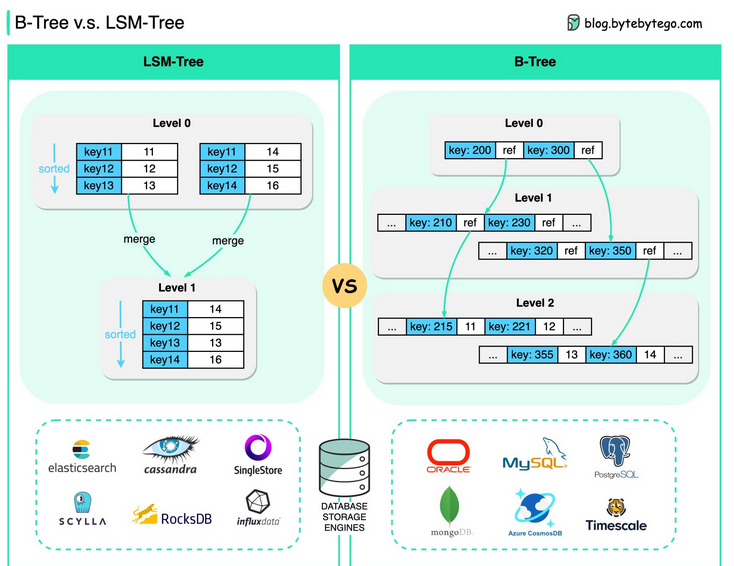
Database Deep Dive: Exploring Storage Engines and Indexing Strategies,LSM-Trees vs. B-Trees
This article was written based on Mohammad Reza Kargar’s presentation.
Modern databases rely on two foundational components: storage engines and indexing strategies, which play a critical role in determining data performance, retrieval efficiency, and scalability. This article compares two prominent indexing structures, Log-Structured Merge Trees (LSM-Trees) and B-Trees, highlighting their distinct designs, advantages, and trade-offs.
LSM-Trees, with their “append-only” log structure, excel in write-intensive workloads and are well-suited for NoSQL databases. In contrast, B-Trees are highly efficient for read-heavy operations, commonly used in relational databases. Understanding these trade-offs is essential for selecting the right indexing strategy to meet specific workload patterns and performance requirements. This exploration, inspired by Mohamad Reza Kargar’s presentation, underscores the importance of tailoring database systems to optimize their foundational structures.
Append-only data structures
This concept is introduced as a foundational element in many modern databases. It involves sequentially writing new data to the end of a file without modifying existing records, simplifying data management and concurrency control.
Append-only Data Structures
In the context of databases, “append-only” refers to a data storage method where new data is always added to the end of a file or sequence. Existing data within the file remains unchanged.
Key Characteristics:
- Sequential Writes: New data is always appended, ensuring efficient write operations.
- Immutability: Once written, existing data cannot be modified directly within the file.
- Simplified Concurrency: Append-only nature minimizes conflicts and simplifies concurrency control mechanisms, as multiple processes can safely write to the end of the file simultaneously.
- Data History: Since data is never overwritten, it provides a complete history of changes, which can be valuable for auditing, debugging, and data recovery.
Examples:
- Log Files: Classic example, used to record system events, transaction history, and application activity.
- Version Control Systems (like Git): Changes are recorded as new commits, creating a chronological history of the codebase.
- Blockchain Technology: Transactions are added to a chain of blocks, forming an immutable and tamper-proof record.
Benefits:
- Improved Write Performance: Sequential writes are generally faster than random writes.
- Enhanced Data Integrity: Immutability reduces the risk of accidental data corruption.
- Simplified Concurrency Control: Minimizes the need for complex locking mechanisms.
Considerations:
- Space Consumption: Continuous growth of the file can lead to space issues.
- Read Performance: Retrieving specific data might require scanning through the entire file, which can be inefficient for large datasets.
Log-structured merge-tree (LSM-tree):
This popular indexing approach builds upon the append-only paradigm. It leverages sorted string tables (SSTables) and a tiered merging process for efficient data storage and retrieval.
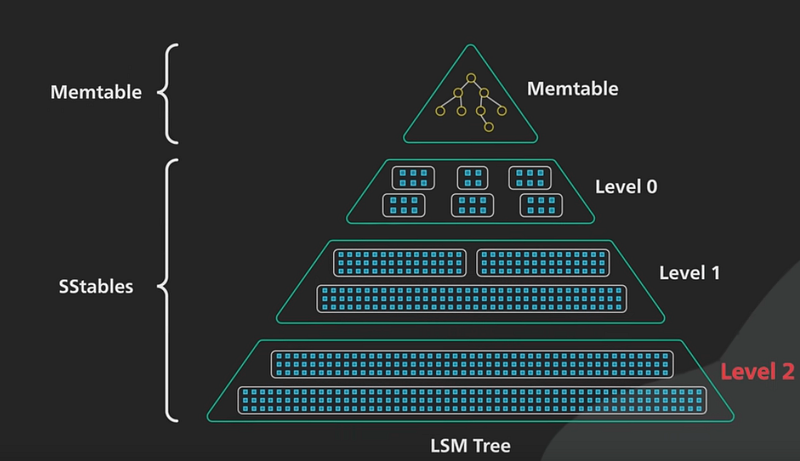
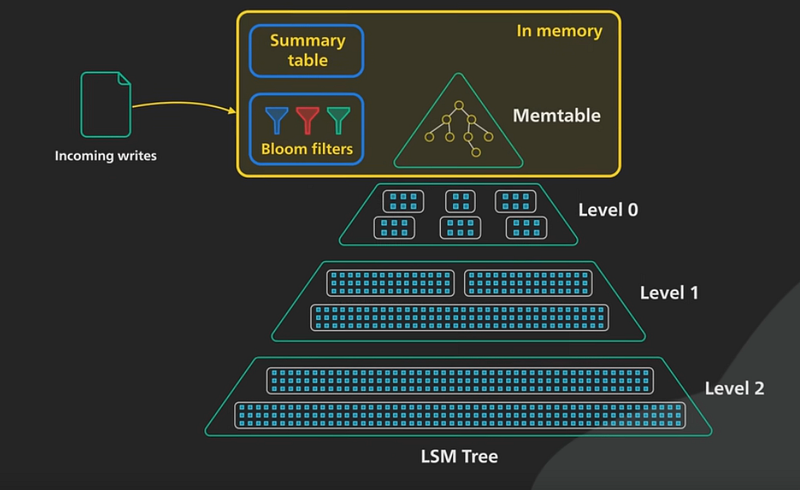
The LSM-tree is a popular indexing technique that builds upon the append-only paradigm. It’s designed to efficiently handle high write volumes while maintaining reasonable read performance. Here’s a breakdown:
Core Concepts:
- Append-Only Principle: New data is always appended to the end of the structure, minimizing random writes and improving write performance.
- Sorted String Tables (SSTables): Data is organized into immutable, sorted files called SSTables. These files are efficiently read sequentially.
- Tiered Structure: LSM-trees typically have multiple levels:
- Memtable: An in-memory data structure (e.g., a balanced tree) that holds recently added data.
- SSTable Levels: Data from the memtable is periodically flushed to disk as SSTables. These SSTables are organized into levels, with each level typically containing larger and more sorted data.
How it Works:
- Writes: New data is initially added to the memtable.
- Flushing: When the memtable reaches a certain size threshold, it is flushed to disk as a new SSTable.
- Merging: Periodically, smaller SSTables are merged into larger, more sorted SSTables. This process reduces the number of files and improves read performance.
- Reads: To find a specific key, the LSM-tree searches the memtable first. If not found, it searches the SSTables in each level, starting from the smallest (most recently written) and progressing to the largest.
Key Advantages:
- High Write Throughput: Appending to files and leveraging in-memory structures significantly improves write performance.
- Efficient Read Performance: Merging and sorting improve data locality, leading to faster reads.
- Space Efficiency: Data is compressed within SSTables, and merging reduces redundancy.
Key Considerations:
- Read Amplification: During merging, multiple reads and writes may be required, potentially impacting read performance.
- Space Amplification: Before merging, there may be temporary space overhead due to multiple copies of the same data.
Use Cases:
- NoSQL Databases: Widely used in databases like Cassandra and LevelDB.
- Time Series Databases: Efficiently handle high volumes of time-stamped data.
- Key-Value Stores: Ideal for applications with frequent writes and occasional reads.
B-trees
A classic tree-based indexing structure commonly employed in relational databases. B-trees ensure sorted key-value storage and facilitate efficient search, range queries, and updates.
B-trees are a fundamental data structure in computer science, particularly well-suited for indexing in databases. They are balanced tree structures that efficiently store and retrieve sorted data.
- Balanced Structure: B-trees maintain a balanced tree shape, ensuring that the height of the tree remains relatively low. This is crucial for efficient search operations.
- Multiple Keys per Node: Unlike binary search trees, B-tree nodes can hold multiple keys and pointers to child nodes. This reduces the overall height of the tree, minimizing the number of disk accesses required for search operations.
- Sorted Order: Keys within each node and across the entire tree are maintained in sorted order.
- Efficient Search: B-trees enable fast searches, insertions, and deletions. The search time complexity is typically logarithmic in the number of keys.
How they work:
- Search: To find a specific key, the B-tree algorithm starts at the root node and traverses down the tree, comparing the search key with the keys in each node.
- Insertion: New keys are inserted into appropriate positions within the tree. If a node becomes full, it is split into two nodes, maintaining the balanced structure.
- Deletion: Deleting a key involves removing it from the node and potentially rebalancing the tree to maintain its structure.
Use Cases:
- Database Indexing: B-trees are widely used as primary or secondary indexes in relational databases. They efficiently support equality searches, range queries, and ordered traversals.
- File Systems: Used in file systems to organize and locate files on disk.
- Databases: Employed in various database systems, including relational databases, NoSQL databases, and time series databases.
Advantages:
- Efficient Search: Logarithmic search time complexity.
- Good for Range Queries: Enables efficient retrieval of data within a specific range.
- Balanced Structure: Maintains good performance even for large datasets.
Limitations:
- Space Overhead: Requires additional space to store the tree structure.
In essence, B-trees are a robust and versatile data structure that plays a vital role in efficient data storage and retrieval in many database systems.
PostgreSQL primarily uses B-tree indexes for most data types.
- Default Index Type: B-tree is the default index type in PostgreSQL.
- Data Types: It supports a wide range of data types that can be sorted, including integers, floating-point numbers, strings, dates, and more.
- Functionality: B-tree indexes are well-suited for:
- Equality Queries: Finding rows where a specific column matches a given value.
- Range Queries: Finding rows where a column value falls within a specified range.
- Ordered Retrieval: Efficiently retrieving data in sorted order.
Key Points:
- Efficiency: B-tree indexes provide efficient search, insertion, and deletion operations, making them a popular choice for many database applications.
- Versatility: Their ability to handle various data types and support different query types makes them highly versatile.
PostgreSQL offers several index engines, each with its own strengths and best suited for different data types and query patterns:
B-tree:
- The default and most widely used index type.
- Excellent for equality, range, and ordered searches.
- Supports a wide range of data types.
Hash:
- Optimized for equality searches.
- Very fast for exact matches but not suitable for range queries or ordered retrieval.
GiST (Generalized Search Tree):
- Designed for indexing complex data types like geometries (points, polygons), arrays, and full-text search.
- Provides efficient search for spatial queries and other complex data structures.
SP-GiST (Space-Partitioned GiST):
- An extension of GiST specifically for spatial data.
- Offers improved performance for certain spatial operations.
GIN (GINdex):
- Optimized for indexing data types that contain multiple elements, such as arrays and full-text documents.
- Enables efficient searches for elements within a set.
BRIN (Block Range Index):
- Suitable for large tables with many rows that exhibit some degree of locality.
- Indexes data within blocks of the table, making it efficient for queries that filter on a range of values.
Choosing the Right Index Engine:
The choice of index engine depends heavily on factors such as:
- Data Type: The type of data being indexed (e.g., integers, strings, geometries, arrays).
- Query Patterns: The types of queries that will be performed on the data (e.g., equality searches, range queries, full-text searches).
What is the problem with a naive approach to database indexing like using a simple hash map?
While a hash map can be used for indexing, it faces several issues in a database context:
- Scalability: A hash map holding the entire index in memory can become too large to manage as the database grows.
- Disk space: Storing the entire index on disk can lead to excessive disk space consumption, particularly with large databases.
- Crash recovery: If the system crashes, reconstructing the hash map from disk can be time-consuming.
What are Sorted String Tables (SSTables) and how do they address the limitations of simple hash maps?
SSTables are a key-value storage format that addresses the problems of naive indexing by storing sorted key-value pairs in segments on disk:
- Sorted Keys: Sorting keys within segments enables efficient searching using binary search or other techniques.
- Disk Segmentation: Dividing the data into segments allows for easier merging and compaction, improving write performance and disk space utilization.
- Merging and Compaction: Background processes merge and compact segments to eliminate duplicate keys and maintain a sorted, efficient structure.
What are Log-Structured Merge-Trees (LSM-Trees) and how do they build upon the concept of SSTables?
LSM-Trees are a data structure that leverages SSTables to provide efficient read and write performance:
- Memtable: Incoming writes are first buffered in memory in a sorted structure called a Memtable.
- Disk Flushing: When the Memtable reaches a threshold size, it is flushed to disk as an SSTable segment.
- Multi-Level Compaction: Segments at different levels are periodically merged and compacted, optimizing storage and read performance.
What are B-Trees and how do they differ from LSM-Trees?
B-Trees are another tree-based data structure used for indexing, offering a different approach compared to LSM-Trees:
- Block-Based Storage: Data is stored in fixed-size blocks on disk, aligning with disk I/O characteristics for efficiency.
- Balanced Tree Structure: The tree is maintained balanced to ensure logarithmic time complexity for search, insert, and delete operations.
- In-Place Updates: Updates are performed directly in the tree, minimizing write amplification compared to LSM-Trees.
What are the trade-offs between LSM-Trees and B-Trees for database indexing?
The choice between LSM-Trees and B-Trees depends on the specific workload and performance requirements:
- Writes: LSM-Trees generally excel in write-intensive workloads due to their append-only nature and efficient sequential writes.
- Reads: B-Trees often exhibit better read performance, particularly for random reads, due to their in-place updates and balanced structure.
- Space Amplification: LSM-Trees can have higher space amplification due to their merging and compaction process.
- Concurrency: B-Trees typically handle concurrency more efficiently due to their block-based structure and latching mechanisms.
What is write amplification and why is it an important consideration in database indexing?
Write amplification refers to the phenomenon where a single logical write to the database results in multiple physical writes to the storage medium.
- Impact: High write amplification can negatively impact write performance, particularly in write-intensive applications.
- LSM-Trees vs. B-Trees: LSM-Trees tend to have higher write amplification due to their merging and compaction process, while B-Trees minimize it with in-place updates.
What are some of the disadvantages of LSM-Trees?
Despite their strengths, LSM-Trees have some drawbacks to consider:
- Compaction Impact: Compaction processes can cause performance variability, potentially leading to increased tail latencies in some cases.
- Space Overhead: Compaction and merging can lead to temporary storage overhead.
- Complexity: Implementing and managing LSM-Trees can be more complex compared to simpler indexing structures.
How can I choose the right indexing structure for my database application?
The optimal indexing structure depends on factors such as:
- Workload: Identify if your application is read-heavy, write-heavy, or a mix of both.
- Performance Goals: Determine the relative importance of read latency, write throughput, and space efficiency.
- Data Characteristics: Consider the size, distribution, and update patterns of your data.
- Database System: Explore the capabilities and limitations of the database system you are using.
Understanding Database Index Structures
Short-Answer Quiz
- What is the primary motivation behind using database indexes?
- Explain the concept of “append-only” logs in the context of database storage engines.
- Describe the fundamental trade-off between read and write performance when comparing B-trees and LSM-trees.
- What is “write amplification” and why is it a concern, particularly in write-intensive database applications?
- Briefly outline the process of inserting a new key-value pair into a B-tree index structure.
- What is the role of a “memtable” in an LSM-tree implementation?
- Explain how sorted string tables (SSTables) improve upon a simple hash map approach for indexing.
- What is the significance of “compaction” in the context of LSM-trees?
- Why might the compaction process in LSM-trees lead to performance spikes? How can these spikes impact an application?
- Briefly discuss the concept of a “branching factor” in B-trees and its influence on performance.
Answer Key
- Database indexes are used to speed up data retrieval operations. They provide a quick lookup mechanism that avoids the need to scan the entire dataset.
- Append-only logs are a storage mechanism where new data is always appended to the end of the log file. This approach simplifies data writing and recovery but requires additional mechanisms for indexing and querying.
- B-trees typically offer faster read performance due to their structure, allowing for efficient search operations. LSM-trees, prioritizing write speed by appending new data, can have slower read times due to the need to merge and compact segments.
- Write amplification refers to the phenomenon where a single logical write operation results in multiple physical writes to the storage medium. This can significantly impact performance, particularly in write-intensive scenarios, by increasing disk I/O and reducing throughput.
- Inserting a key-value pair into a B-tree involves searching for the appropriate leaf node based on the key. If space is available in the leaf, the pair is inserted. If not, the node is split, and the tree structure is rebalanced.
- A memtable acts as an in-memory buffer in LSM-trees, holding recently written data in a sorted order. Once it reaches a certain size, its contents are flushed to disk as an SSTable.
- SSTables improve upon hash maps by storing key-value pairs in a sorted order within each segment. This sorting enables efficient range queries and binary search within segments.
- Compaction in LSM-trees merges and rewrites SSTables to eliminate duplicate keys, reclaim space from deleted data, and improve read performance by reducing the number of segments to scan.
- The compaction process, while beneficial in the long run, can lead to temporary performance spikes as it involves significant I/O operations. These spikes can impact an application by causing increased latency and response time variability.
- The branching factor in a B-tree refers to the number of child nodes a node can have. A higher branching factor leads to a shallower tree, reducing the number of levels traversed during search operations and generally improving performance.
Essay Questions
- Compare and contrast the advantages and disadvantages of using B-tree and LSM-tree index structures in various database applications. Consider factors such as read/write workload, data size, and performance requirements.
- Discuss the concept of write amplification in detail. Explain how it arises in different index structures and outline strategies for minimizing its impact.
- Explain the role of compaction in LSM-trees. Describe the different levels of compaction and discuss the trade-offs involved in choosing a compaction strategy.
- Analyze the challenges of concurrency control in index structures. Discuss different locking mechanisms and how they address issues related to simultaneous read and write operations.
- Explain how the choice of an appropriate index structure can be influenced by the specific characteristics of a dataset and the expected query patterns. Provide examples to illustrate your points.
Glossary of Key Terms
Append-only Log: A storage mechanism where new data is always appended to the end of a log file. B-tree: A self-balancing tree data structure commonly used for indexing in databases, enabling efficient search, insertion, and deletion operations. Branching Factor: The number of child nodes a node can have in a B-tree. Compaction: A process in LSM-trees that merges and rewrites SSTables to eliminate duplicates, reclaim space, and improve read performance. Hash Map: A data structure that uses a hash function to map keys to their corresponding values, providing fast average-case lookup performance. Index: A data structure that speeds up data retrieval in a database by providing a quick lookup mechanism based on specific keys. LSM-tree (Log-Structured Merge-Tree): A storage engine that prioritizes write performance by appending new data to an append-only log and using background merges to optimize read performance. Memtable: An in-memory buffer in LSM-trees that holds recently written data in a sorted order. SSTable (Sorted String Table): A file format used in LSM-trees to store key-value pairs in a sorted order within each segment. Write Amplification: The phenomenon where a single logical write operation results in multiple physical writes to the storage medium.
Conclusion
The exploration of storage engines and indexing strategies reveals the critical role they play in modern database systems. LSM-Trees and B-Trees, two foundational indexing structures, each offer distinct strengths tailored to different workload patterns. LSM-Trees excel in write-intensive scenarios, leveraging their append-only nature and efficient data compaction processes. On the other hand, B-Trees provide exceptional read performance, making them ideal for read-heavy applications with frequent range queries.
Choosing the appropriate indexing structure involves understanding trade-offs in write amplification, read efficiency, and concurrency control. By aligning database design with workload demands and performance goals, developers can harness the full potential of these structures to build robust, scalable, and efficient systems. This nuanced understanding underscores the importance of strategic decisions in database architecture, ultimately shaping the
Thank you for being a part of the community
Before you go:
- Be sure to clap and follow the writer ️👏️️
- Follow us: X | LinkedIn | YouTube | Newsletter | Podcast
- Check out CoFeed, the smart way to stay up-to-date with the latest in tech 🧪
- Start your own free AI-powered blog on Differ 🚀
- Join our content creators community on Discord 🧑🏻💻
- For more content, visit plainenglish.io + stackademic.com