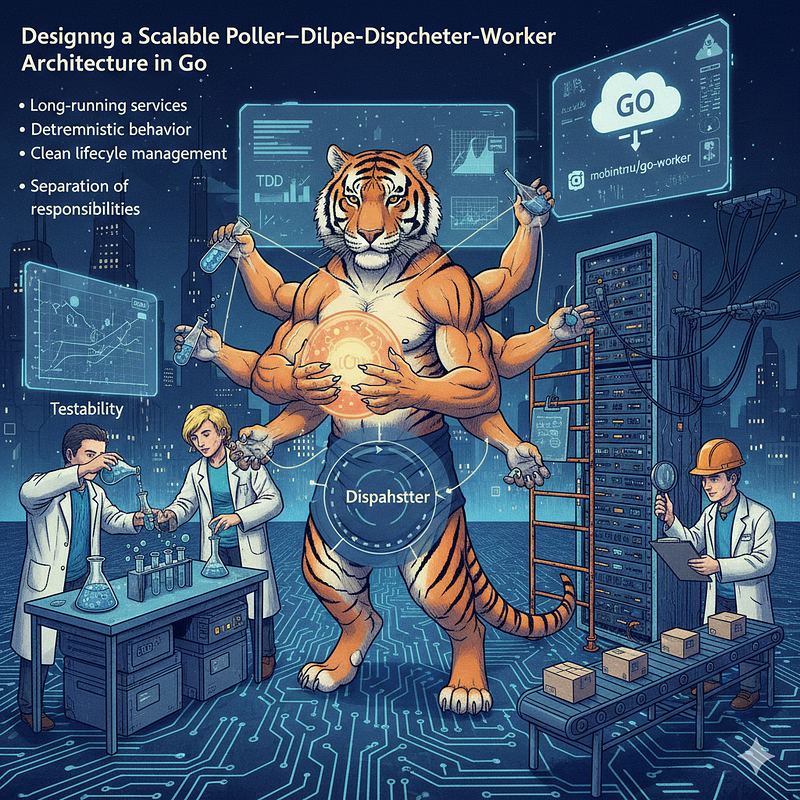
Designing a Scalable Poller–Dispatcher–Worker Architecture in Go
Introduction
Background job processing is a foundational building block in modern backend systems. Whether handling email delivery, data synchronization, cache warming, or event-driven workflows, a well-designed job execution pipeline must be scalable, testable, and operationally safe.
This article presents a production-ready design for a Poller–Dispatcher–Worker–Job architecture in Go, optimized for:
- Long-running services
- Deterministic behavior
- Clean lifecycle management
- High testability
Go-Worker
Go-worker is an open source project and has a simple impediment of a Poller–Dispatcher–Worker–Job architecture in Go.
Core Design Goals
The system is designed around the following principles:
- Separation of responsibilities
- Explicit control flow
- Safe concurrency
- Graceful startup and shutdown
- Test-first architecture
High-Level Architecture
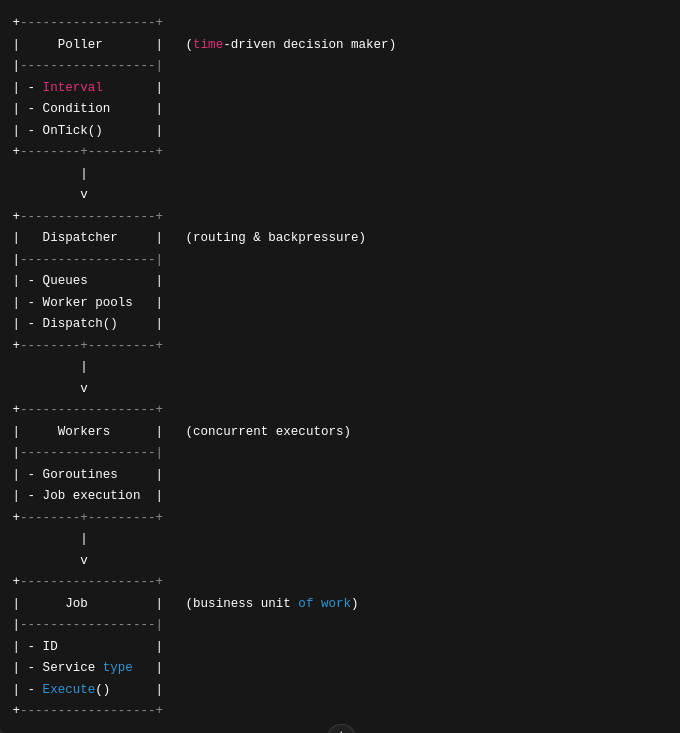
Component Responsibilities
1. Job: The Atomic Unit of Work
A Job represents a single business action.
type Job interface {
    ID() string Service() string Execute(ctx context.Context) error
}
Key characteristics:
- Stateless or minimally stateful
- Self-contained
- Retry-safe
- Executable independently
2. Worker: Concurrent Job Executor
Workers are long-lived goroutines that process jobs from a channel.
type Worker interface {
    Start(ctx context.Context) Stop()
}type SimpleWorker struct {
id int jobQueue <-chan job.Job cancel context.CancelFunc
}
func NewSimpleWorker(id int, jobQueue <-chan job.Job,) *SimpleWorker {
return &SimpleWorker{
id: id, jobQueue: jobQueue,
}
}
func (w *SimpleWorker) Start(ctx context.Context) {
ctx, cancel := context.WithCancel(ctx) w.cancel = cancel go func() {
log.Printf("[worker-%d] started\n", w.id) for {
//blocker select {
case <-ctx.Done():
log.Printf("[worker-%d] stopped\n", w.id)
return case j := <-w.jobQueue:
w.handleJob(ctx, j)
}
}
}
()
}
func (w *SimpleWorker) Stop() {
if w.cancel != nil {
w.cancel()
}
}
func (w *SimpleWorker) handleJob(ctx context.Context, j job.Job) {
log.Printf("[worker-%d] executing job id=%s service=%s\n", w.id, j.ID(), j.Service(),) if err :=
j.Execute(ctx);
err != nil {
log.Printf("[worker-%d] job failed id=%s error=%v\n", w.id, j.ID(), err,)
}
}Workers:
- Block on job queues
- Execute jobs synchronously
- Report success or failure
- Never make scheduling decisions
Design rule:
Workers execute work — they never decide what work to run.
3. Dispatcher: Routing and Backpressure Control
The dispatcher is responsible for:
- Managing job queues
- Enforcing concurrency limits
- Routing jobs to the correct worker pool
type Dispatcher interface {
    Start() Stop() Dispatch(j job.Job) error
}
var ErrServiceNotRegistered = errors.New("service not registered"
)
type Service struct {
    ctx
    context.Context cancel context.CancelFunc mu sync.RWMutex queues map[string]chan job.Job workers
    map[string][]worker.Worker
}
func New() *Service {
    ctx, cancel := context.WithCancel(context.Background()) return &Service{
        ctx: ctx, cancel: cancel, queues: make(map[string]chan job.Job), workers:
        make(map[string][]worker.Worker),
    }
}
func (d *Service) Register(service string, workerCount int, queueSize int,) {
    d.mu.Lock() defer d.mu.Unlock() if _, exists := d.queues[service];
    exists {
        fmt.Println("service already registered") return
    }
    queue := make(chan job.Job, queueSize) d.queues[service] = queue var workers []worker.Worker for
    i := 0;
    i < workerCount;
    i++ {
        w := worker.NewSimpleWorker(i+1, queue) workers = append(workers, w)
    }
    d.workers[service] = workers
}
func (d *Service) Start() {
    d.mu.RLock() defer d.mu.RUnlock() for _, ws := range d.workers {
        for _, w := range ws {
            w.Start(d.ctx)
        }
    }
}
func (d *Service) Dispatch(j job.Job) error {
    // Prevent dispatch after stop select {
        case <-d.ctx.Done(): return context.Canceled default:
    }
    d.mu.RLock() queue, ok := d.queues[j.Service()] d.mu.RUnlock() if !ok {
        return ErrServiceNotRegistered
    }
    // Safe send select {
        case queue <- j: return nil case <-d.ctx.Done(): return context.Canceled
    }
}
func (d *Service) Stop() {
    d.cancel() d.mu.RLock() defer d.mu.RUnlock() for _, q := range d.queues {
        close(q)
    }
}
func RegisterLifecycle(lc fx.Lifecycle, d *Service) {
    lc.Append(fx.Hook{
        OnStart: func(ctx context.Context) error {
            fmt.Println("starting dispatcher...") d.Start() return nil
        }, OnStop: func(ctx context.Context) error {
            fmt.Println("stopping dispatcher...") d.Stop() return nil
        },
    })
}
func RegisterServices(d *Service) {
    // Example services d.Register("email", 5, 100)
}
Each service has:
- Its own buffered queue
- A dedicated worker pool
- Independent scaling characteristics
This design allows:
- Different SLAs per service
- Backpressure isolation
- Clear failure domains
4. Poller: Time-Based Decision Engine
The poller is the control plane of the system.
/*Fx App ├── Dispatcher (long-lived) │
└── Worker pools ├── Poller (long-lived background process) │
└── Infinite loop │ ├── Check condition (DB / cache / API) │ └── Dispatch job(s) └── Servers*/type
Poller struct {
    Dispatcher *dispatcher.Service Interval time.Duration ctx context.Context cancel
    context.CancelFunc OnTick func(context.Context)
}
func New(dispatcher *dispatcher.Service,) *Poller {
    p := &Poller{
        Dispatcher: dispatcher, Interval: 500 * time.Microsecond,
    }
    p.OnTick = p.DefaultTick // default behavior
    return p
}
func (p *Poller) Run(ctx context.Context) {
    ticker := time.NewTicker(p.Interval) defer ticker.Stop() for {
        fmt.Println("poller For loop ...") select {
            case <-ctx.Done(): return case <-ticker.C: p.OnTick(ctx)
        }
    }
}
func (p *Poller) DefaultTick(ctx context.Context) {
    // Example condition (replace with DB/cache logic) log.Println("DefaultTick is running ...") if
    !p.conditionMet(ctx) {
        return
    }
    j := example.NewExampleJob("job-123", "email") _ = p.Dispatcher.Dispatch(j)
}
func (p *Poller) conditionMet(ctx context.Context) bool {
    // DB / Redis / API / feature flag / backlog size
    return true
}
func RegisterLifecycle(lc fx.Lifecycle, p *Poller) {
    lc.Append(fx.Hook{
        OnStart: func(ctx context.Context) error {
            fmt.Println("starting dispatcher...") p.ctx, p.cancel =
            context.WithCancel(context.Background()) go p.Run(p.ctx) return nil
        }, OnStop: func(ctx context.Context) error {
            fmt.Println("stopping poller...") if p.cancel != nil {
                p.cancel()
            }
            return nil
        },
    })
}Responsibilities:
- Runs on a fixed interval
- Checks conditions (DB, Redis, API, flags)
- Decides whether to create jobs
- Dispatches jobs via the dispatcher
Key rule:
The poller decides when and what to run — never how.
Poller Execution Model
func (p *Poller) Run(ctx context.Context) {
    ticker := time.NewTicker(p.Interval) defer ticker.Stop() for {
        select {
            case <-ctx.Done(): return case <-ticker.C: p.OnTick(ctx)
        }
    }
}
Why This Matters
- Single execution path
- No hidden logic
- Fully overridable for tests
- Deterministic timing
Lifecycle Management (Uber Fx Friendly)
Each long-lived component follows the same pattern:
func Register(lc fx.Lifecycle, svc Service) {
    lc.Append(fx.Hook{
        OnStart: func(ctx context.Context) error {
            svc.Start() return nil
        }, OnStop: func(ctx context.Context) error {
            svc.Stop() return nil
        },
    })
}
This ensures:
- Clean startup ordering
- Graceful shutdown
- No orphan goroutines
- Controlled resource release
Backpressure and Safety
The dispatcher enforces safety through:
- Bounded queues
- Non-blocking dispatch
- Service-level isolation
func (d *serviceDispatcher) Dispatch(job Job) error {
    select {
        case d.queues[job.Service()] <- job: return nil default: return ErrQueueFull
    }
}
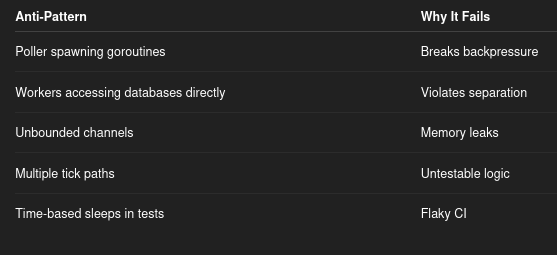
This prevents:
- Memory leaks
- Goroutine explosion
- Cascading failures
Testability by Design
The system is designed for deterministic testing.
Poller Test Example
p.OnTick = func(ctx context.Context) {
	tickCount.Add(1)
}
Dispatcher Test Example
err := dispatcher.Dispatch(job)require.NoError(t, err)Worker Test Example
job.Execute = func(ctx context.Context) error {
    executed.Store(true) return nil
}
No mocks of time.
No sleeps in production logic.
No hidden side effects.
Tests
Operational Benefits
This architecture enables:
- Horizontal scalability
- Clear observability boundaries
- Per-service tuning
- Graceful degradation
- Predictable behavior under load
Common Anti-Patterns Avoided
When to Use This Architecture
Ideal for:
- Background processing systems
- Scheduled workflows
- Event polling services
- ETL task orchestration
- Microservice sidecars
Conclusion
A Poller–Dispatcher–Worker architecture succeeds or fails based on clarity of responsibility and explicit control flow.
By separating:
- Decision making (Poller)
- Routing and scaling (Dispatcher)
- Execution (Worker)
- Business logic (Job)
This design is simple enough to start small, yet robust enough to scale into production-grade workloads.
Your Business — On AutoPilot with DDImedia AI Assistant
(Join Our Waitlist)
Visit us at DataDrivenInvestor.com
Join our creator ecosystem here.
DDI Official Telegram Channel: https://t.me/+tafUp6ecEys4YjQ1