Serving an Offline GraphQL Playground in Go: Avoiding the Gin Static File Pitfalls
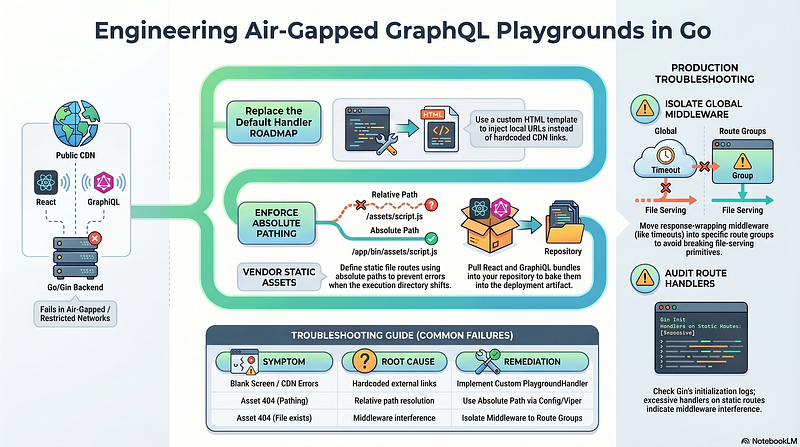
When building a GraphQL API in Go using gqlgen and Gin, the built-in playground.Handler is the standard way to serve the GraphiQL UI. Out of the box, it injects an HTML page that loads its assets—React, ReactDOM, and the GraphiQL CSS/JS bundle—directly from a public CDN:
https://cdn.jsdelivr.net/npm/[email protected]/umd/react.production.min.js
https://cdn.jsdelivr.net/npm/[email protected]/umd/react-dom.production.min.js
https://cdn.jsdelivr.net/npm/[email protected]/graphiql.min.css
https://cdn.jsdelivr.net/npm/[email protected]/graphiql.min.js
This is fine for local development with unrestricted internet access. However, in enterprise environments — such as air-gapped servers, corporate networks with strict egress filtering, Kubernetes clusters governed by zero-trust network policies, or production environments where you cannot depend on third-party availability — these CDN requests will fail silently. Your users will be greeted with a blank screen and a console full of network errors.
The architectural fix is straightforward: serve the assets yourself. However, implementing this within a Go/Gin ecosystem reveals several subtle, non-obvious engineering pitfalls. Here is how to self-host these assets reliably.
The Architecture: Self-Hosting Assets
To make your GraphQL playground entirely self-hosted, we need to bypass the default CDN-dependent handler and serve assets directly from our backend binary or local filesystem.
Here is the step-by-step engineering roadmap to implement this decoupled architecture.
Step 1: Replace playground.Handler with a Custom Template
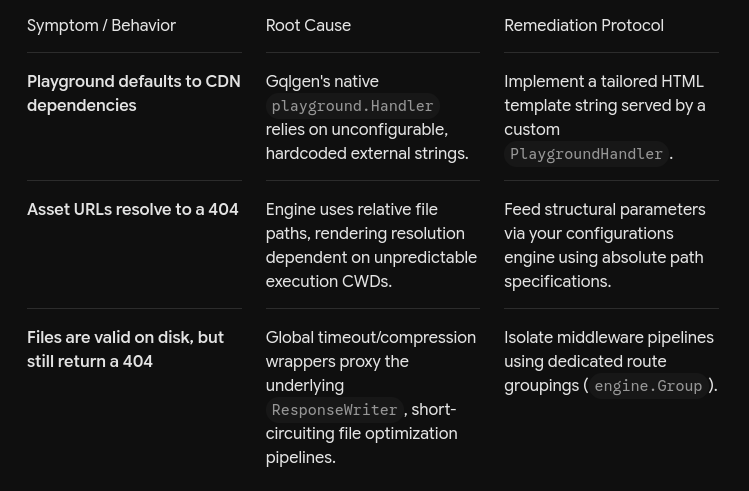
The first implementation hurdle is that gqlgen’s playground.Handler hardcodes the CDN URLs in its underlying HTML template. There is no configuration hook to override them.
To fix this, we must write a custom playground handler that injects local /static/* URLs into our own HTML template:
package server

import (
	"html/template"
	"net/http"

	"github.com/gin-gonic/gin"
)

var playgroundTmpl = template.Must(template.New("playground").Parse(`<!DOCTYPE html>
<html>
  <head>
    <title>GraphQL Playground</title>
    <meta charset="utf-8" />
    <meta name="viewport" content="width=device-width, initial-scale=1" />
    <link rel="stylesheet" href="/static/graphiql.min.css" />
  </head>
  <body style="margin:0;">
    <div id="graphiql" style="height:100vh;"></div>
    <script src="/static/react.production.min.js"></script>
    <script src="/static/react-dom.production.min.js"></script>
    <script src="/static/graphiql.min.js"></script>
    <script>
      const fetcher = GraphiQL.createFetcher({ url: '{{.Endpoint}}' });
      ReactDOM.render(
        React.createElement(GraphiQL, { fetcher }),
        document.getElementById('graphiql'),
      );
    </script>
  </body>
</html>`))

func PlaygroundHandler(endpoint string) gin.HandlerFunc {
	return func(c *gin.Context) {
		c.Header("Content-Type", "text/html; charset=utf-8")
		c.Status(http.StatusOK)
		playgroundTmpl.Execute(c.Writer, map[string]string{
			"Endpoint": endpoint,
		})
	}
}
Now, mount this handler within your routing configuration:
// Legacy Implementation (CDN Dependent):
// engine.GET("/playground", gin.WrapH(playground.Handler("GraphQL Playground", "/query")))

// Current Implementation (Self-Hosted):
engine.GET("/playground", PlaygroundHandler("/query"))
💡 Design Pattern Note: Always use absolute paths (/static/graphiql.min.css) instead of relative paths (./static/...). Relative paths resolve against the browser's current URL context. If your playground route is ever modified or nested (e.g., /admin/playground), relative paths will break. Absolute paths guarantee resolution consistency.
Step 2: Vendoring the Static Files
The static assets must be pulled down into your repository control layer so they can be baked into your final deployment artifact (e.g., a Docker image).
mkdir -p ./static

curl -L -o ./static/react.production.min.js \
  https://cdn.jsdelivr.net/npm/[email protected]/umd/react.production.min.js

curl -L -o ./static/react-dom.production.min.js \
  https://cdn.jsdelivr.net/npm/[email protected]/umd/react-dom.production.min.js

curl -L -o ./static/graphiql.min.css \
  https://cdn.jsdelivr.net/npm/[email protected]/graphiql.min.css

curl -L -o ./static/graphiql.min.js \
  https://cdn.jsdelivr.net/npm/[email protected]/graphiql.min.js
Verify your file structure matches the target manifest:
static/

├── react.production.min.js       (~10 KB)

├── react-dom.production.min.js   (~130 KB)

├── graphiql.min.css              (~418 KB)

└── graphiql.min.js               (~1.0 MB)
Step 3: Registering the Static Route with Absolute Paths
Using Gin’s engine, we can serve this directory using the r.Static() method.
func RegisterStaticRoutes(r *gin.Engine, cfg *config.Config) {
	r.Static("/static", cfg.StaticCacheDir)
}
We map StaticCacheDir via an environment variable using an options pattern or a configuration guide like Viper:
// config/config.go
type Config struct {
	HTTPPort       int
	HTTPAddress    string
	StaticCacheDir string
}

func buildConfig(v *viper.Viper) *Config {
	return &Config{
		StaticCacheDir: v.GetString("STATIC_CACHE_DIR"),
	}
}# .env.development
APP_STATIC_CACHE_DIR=/home/user/projects/graphql_api/static(Assuming viper.SetEnvPrefix("APP") handles standard environment mapping).
Why Avoid Relative Paths for Server Directories?
Hardcoding r.Static("/static", "./static") evaluates paths relative to the current working directory (CWD) of the running binary. If a service is invoked outside its root folder (e.g., go run ./cmd/server/main.go), or run inside automated container engines, systemd, or orchestration runtimes, the CWD shifts, and Gin will throw silent filesystem errors. Forcing an absolute path via configuration enforces operational safety.
Step 4: The Hidden Culprit — Middleware Interference
During deployment, you might find that despite proper path resolution and verified local files, asset routes still throw unexpected 404 Not Found errors:
[GIN] 2026/04/18 - 11:06:15 | 404 | 828.24μs | 127.0.0.1 | GET "/static/graphiql.min.css"The underlying cause is almost always global middleware interference — specifically wrappers like github.com/gin-contrib/timeout.
When middleware is attached globally via r.Use(...), it intercepts every engine register entry, including static routes. Timeout middleware intercepts and wraps Gin’s native http.ResponseWriter. This wrapper disrupts Go's underlying http.ServeContent engine, which requires direct, unwrapped access to the native response channel to handle file optimization mechanisms (like chunking, caching headers, and ranges). Unable to process the channel properly, Gin drops execution and down-routes to a 404.
The Fix: Scope Isolation
Isolate your middleware application. Remove global response-wrapping utilities from the base engine and isolate them strictly to API route groups.
// BROKEN: Global scope blocks r.Static() execution mechanics
func NewGinEngine() *gin.Engine {
	r := gin.New()
	r.Use(
		gin.Logger(),
		gin.Recovery(),
		timeout.New(timeout.WithTimeout(60*time.Second)),
	)
	return r
}

// REMEDY: Clean core execution engine
func NewGinEngine() *gin.Engine {
	r := gin.New()
	r.Use(gin.Logger(), gin.Recovery())
	return r
}
Isolate timeouts specifically to the endpoints requiring transactional computational deadlines:
func RegisterRoutes(engine *gin.Engine, cfg *config.Config, graphqlHandler http.Handler) {
	// Static asset delivery — Zero execution wrapping, served directly from disk
	RegisterStaticRoutes(engine, cfg)

	// Functional API Routes — Execution boundaries protected by isolated middleware
	api := engine.Group("/")
	api.Use(timeout.New(timeout.WithTimeout(60 * time.Second)))

	api.POST("/query", gin.WrapH(graphqlHandler))
	api.GET("/playground", PlaygroundHandler("/query"))
}
Production Debugging Checklist
If your local static files continue throwing 404s, step down this verification pipeline sequentially:
Verify Engine Mapping Traversal Print your active routing table during initialization to ensure asset namespaces map correctly:
for _, r := range engine.Routes() {
	log.Printf("Route Registered: %s %s", r.Method, r.Path)
}
Confirm that GET /static/*filepath is explicitly bound.
Validate Sandbox File Visibility Assert filesystem permissions and absolute paths before boot initialization completes:
files := []string{
	cfg.StaticCacheDir + "/react.production.min.js",
	cfg.StaticCacheDir + "/graphiql.min.css",
}

for _, f := range files {
	if _, err := os.Stat(f); err != nil {
		log.Fatalf("Fatal: Missing asset visibility at path: %s", f)
	}
}
Check for NoRoute Masking If your application uses a catch-all engine.NoRoute handler to return a uniform JSON error payload, it will swallow native underlying error descriptions, making filesystem initialization faults look like simple routing bugs.
Audit Middleware Interception Count Review Gin’s initialization logs: GET /static/*filepath (4 handlers).
If the count of handlers exceeds your explicitly declared middleware pipeline stack, an inherited middleware layer is wrapping your asset endpoint.
Final Architecture Map
project/
├── static/
│   ├── react.production.min.js
│   ├── react-dom.production.min.js
│   ├── graphiql.min.css
│   └── graphiql.min.js
├── internal/
│   └── server/
│       ├── gin.go          // Engine initialization (No global timeout middleware)
│       ├── routes.go       // Route group grouping & scope segregation
│       ├── static.go       // Local asset serving handlers
│       └── playground.go   // Custom HTML isolated handler
├── cmd/
│   └── server/
│       └── main.go
└── .env.development
Technical Summary
Core Takeaway: Web application frameworks like Gin use optimization paths for processing filesystem IO. Global middleware that modifies data-stream delivery semantics can break file-serving primitives. Isolate your static assets from structural transaction middleware to keep your offline capabilities dependable.