Introduction
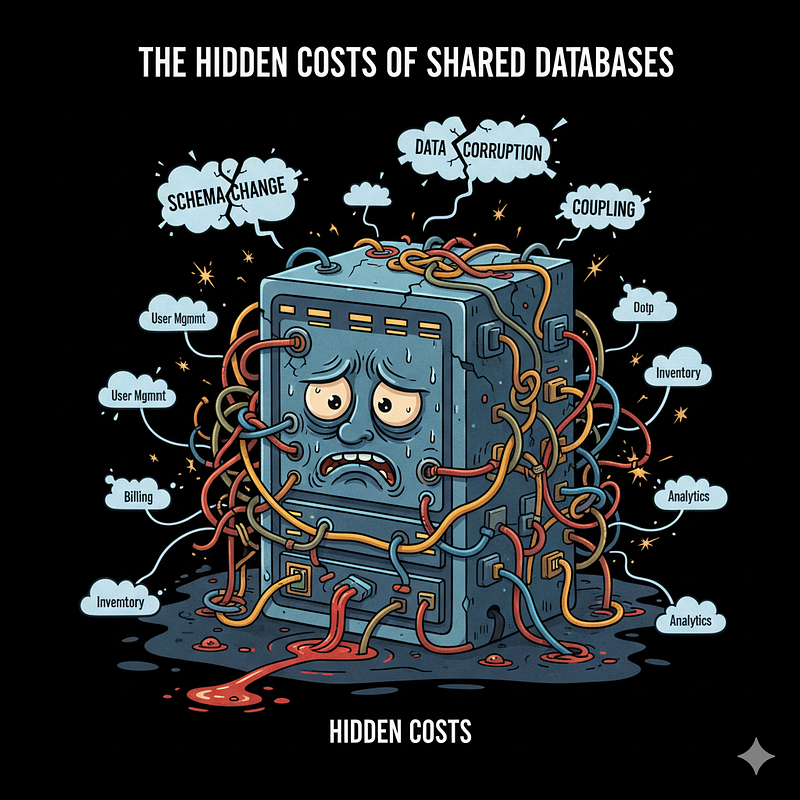
In modern microservice architectures, one of the most dangerous shortcuts is allowing multiple services to share a single database schema. While it may seem efficient on the surface — avoiding duplication and simplifying initial deployment — sharing a database across services introduces cascading problems that undermine the core benefits of microservice design: independence, scalability, and resilience.
This article explores the major technical challenges that arise when services depend on a shared database, grounded in real-world scenarios and industry best practices.
1. Tight Coupling Through Shared Schema
The Problem
When services access the same database tables, the schema becomes an implicit, tightly-enforced contract between them. Any change to the database structure — adding a column, renaming a table, or modifying constraints — potentially breaks other services that depend on it.
Why This Matters
Unlike a well-defined API where breaking changes are deliberate and versioned, schema changes often happen without proper coordination. A developer might rename a customer_id column to customer_uuid in one service’s logic, unaware that a sibling service hardcodes references to the old name. The result: silent data corruption or runtime errors across the system.
Real-World Example
Imagine Service A (User Management) and Service B (Billing) both read from a shared customers table. Service A's team decides to add a new customer_type column to support enterprise accounts. If Service B's queries weren't updated, or if the new column lacks a sensible default, billing calculations could fail silently, leading to missed revenue or incorrect charges.
Deployment Cascade
This coupling destroys independent deployment — a cornerstone of microservices. When Service A needs to make a schema change, teams must coordinate with Service B and any other services that use the same tables. This typically means:
- Joint testing cycles
- Synchronized deployment windows
- Backward-compatibility stubs to support multiple service versions
- Rollback complexity if something goes wrong
The result feels less like microservices and more like a distributed monolith.
2. Data Integrity and Consistency Challenges
Broken Invariants
In a properly designed system, each service owns its data and enforces its own business rules. With a shared database, there’s no clear “owner” to maintain invariants. One service might update data without triggering another service’s validation logic.
Example: A payment service increments an order’s transaction count while simultaneously the inventory service decrements it for stock management. Without proper locking or transactional coordination, the final count could be inconsistent.
Hidden Dependencies
Shared schemas become tangled webs of cross-service dependencies. A simple foreign key relationship might link tables owned by three different teams. Removing or modifying that relationship requires tracing through all dependent services — a debugging nightmare in large systems.
Schema Migration Hazards
Database migrations in a shared environment are risky. A column rename or deletion that seems safe for one service could silently break another. The danger is that errors may not surface immediately; a service might continue running until it encounters the missing column, causing failures in production rather than during testing.
Critical Principle: Schema changes should be treated as external API changes and made with extreme care, as schema mismatches on read are permanent failures.
3. Performance Bottlenecks and Scalability Limits
Resource Contention
All services compete for the same CPU, memory, and I/O resources on a single database server. When one service runs a heavy reporting query or processes a batch job, it starves other services of resources. A “noisy neighbor” effect emerges where one service’s poor performance cascades across the entire system.
Locking and Deadlocks
Because all transactions flow through the same database, long-running operations in one service can lock critical tables and block others. For instance, if the Sales service runs a complex transaction on the customers table while the Customer service tries to update customer records, the Customer service stalls until the lock is released.
Single Point of Failure
A shared database is a critical bottleneck. If the database server becomes overwhelmed or goes offline, all services fail simultaneously. There’s no graceful degradation — the entire system becomes unavailable.
Heterogeneous Data Needs
Different services often have vastly different data access patterns. A transactional service (OLTP) needs low-latency, small reads and writes. An analytics service (OLAP) needs bulk scans and complex joins. A one-size-fits-all database tuning approach (indices, caching, partitioning) inevitably compromises performance for everyone. Optimizing for one service’s workload often hurts another’s.
4. Deployment and Versioning Risks
Coordinated Schema Changes
Every schema change becomes a cross-service release event. Service A cannot deploy independently if it requires a schema change that Service B also consumes. Teams must orchestrate joint deployments or maintain backward-compatible stubs, adding friction and latency to release cycles.
Backward Compatibility Burden
Database migrations are effectively cross-service API changes. A seemingly minor migration — adding a NOT NULL constraint — could break an older version of Service B that expects NULL values. Every migration must account for all active service versions in production, a complex constraint that stifles evolution.
Version Skew and Rollback Complexity
Rolling back one service doesn’t cleanly roll back its database changes. If Service A’s deployment fails and you roll it back, but Service B has already consumed the new schema, you’re left in an inconsistent state. The rollback process becomes intricate and risky.
5. Security and Access Control Complications
Expanded Attack Surface
A shared database means any security vulnerability in one service can compromise the entire dataset. If an attacker exploits a flaw in Service A, they gain access to all data Service B also uses. The blast radius of a single breach multiplies.
Least Privilege Violations
In practice, services typically receive overly broad database credentials. Granting each service only the minimal permissions it needs (the principle of least privilege) is difficult when schemas are intertwined. Services often end up with read/write access to tables they don’t strictly own, making accidental or intentional cross-service misuse easy.
Audit and Compliance Challenges
Tracking which service performed which database operation becomes murky. When multiple services write to the same tables, audit trails become ambiguous. Compliance requirements — especially in regulated industries — demand clear accountability, which shared databases make harder to maintain.
6. Testing and Staging Difficulties
Coupled Test Environments
Shared databases often force a shared staging environment. Multiple teams cannot test independently without interfering with each other. If Team A runs integration tests that populate test data, Team B’s tests might see an unexpected state. This leads to flaky tests, false positives, and wasted debugging cycles.
Non-Isolated Tests
When tests from different services run in parallel against shared tables, conflicts arise. Two integration tests might simultaneously modify the same records, causing one to fail due to unexpected state changes. Test data setup and teardown become complex and fragile.
Environment Drift
Shared staging environments are susceptible to configuration drift, where their state slowly diverges from production. If Service A’s DB migration runs locally but not in staging, tests pass locally but fail in CI/CD. This erodes trust in integration tests and slows down feedback cycles.
Delayed Feedback
Feature branches often require waiting for shared DB updates. If one team needs a schema change for their feature, other teams’ tests may be blocked until that change is applied. This creates bottlenecks in CI/CD pipelines and hampers rapid iteration.
7. Reduced Team Autonomy
Schema as Implicit API
The shared database becomes an invisible contract that all teams must respect. A developer cannot propose a schema change without first surveying all other services to understand dependencies. This creates coordination overhead that scales poorly as more services are added.
Team Coordination Overhead
Each team loses independence. Every schema change, data model adjustment, or optimization decision requires communication with other teams. As the number of services grows, this coordination becomes a bottleneck, and decision-making slows.
Deployment Lockstep
Services lose the agility to deploy independently on their own schedule. Teams often resort to synchronized release windows to avoid incompatibilities, eliminating one of microservices’ key advantages: independent, frequent deployments.
How to Separate Databases Between Services
Separating databases is the key step toward achieving true microservice independence. The goal is clear: each service owns its own data and exposes it only via APIs or events.
Step 1: Identify Service Boundaries
Analyze the existing schema and group tables by domain responsibility using bounded contexts from domain-driven design:
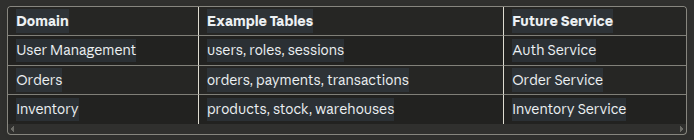
Each service becomes the sole owner of its data, eliminating ambiguity about who controls what.
Step 2: Choose the Right Level of Isolation
Evaluate your organization’s maturity and constraints:
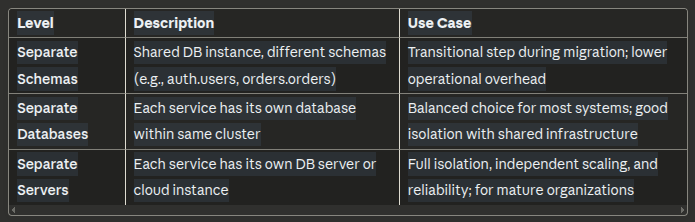
Start with separate schemas if you’re just beginning; migrate to separate databases as teams mature; move to separate servers for maximum independence.
Step 3: Stop Cross-Service SQL Access
This is non-negotiable. Remove all direct SQL joins between services.
❌ Instead of direct queries:
SELECT *
FROM orders
WHERE user_id = 123;
✅ Use REST APIs:
orders := orderService.GetOrdersByUser(userID)✅ Or listen for asynchronous events:
Subscribe to OrderCreated eventsProcess and store reference data locallyDirect database access bypasses all service boundaries and defeats the entire purpose of separation.
Step 4: Sync Data with Events or Replicas
If one service needs data from another, establish clear patterns:
Event-Driven Replication
Publish events when state changes (UserCreated, OrderPaid, InventoryUpdated). Other services consume these events and maintain local read-only copies of reference data. This preserves independence while keeping data available.
CQRS Pattern
Separate read and write models. Services write to their own database and publish events. A separate read service maintains projections optimized for query patterns, eliminating the need for cross-service joins.
API Caching and Read Replicas
Cache frequently accessed reference data. Use read replicas for data that changes infrequently, is refreshed periodically, or is updated via events.
Step 5: Execute Gradual Migration
To safely move away from a shared database:
- Duplicate tables to new service-specific databases.
- Redirect read queries to the new database.
- Redirect write operations after thorough verification.
- Remove shared database access only after a grace period.
Use Change Data Capture (CDC) tools like Debezium or dual-write strategies to keep data in sync temporarily. This phased approach minimizes risk and allows for quick rollback if issues arise.
Step 6: Enforce Isolation and Governance
- Give each service its own database credentials with minimal required permissions.
- Apply connection isolation and separate migration pipelines per service.
- Monitor and audit data ownership to prevent regression.
- Treat database schemas like private APIs — never expose internals to other services.
- Version all schema changes and require approval from the service owner.
Step 7: Example Separated Architecture
┌─────────────────────┐    ┌────────────────────┐    ┌─────────────────────┐
│ Auth Service        │    │ Order Service      │    │ Inventory Service   │
│ REST / gRPC / Kafka │    │ REST / Kafka       │    │ REST / Kafka        │
└────────┬────────────┘    └────────┬───────────┘    └────────┬────────────┘
         │                          │                         │
         ▼                          ▼                         ▼
    auth_db                    order_db                 inventory_db
Each service:
- Owns its schema and migrations
- Scales and deploys independently
- Communicates via APIs or events only
- Fails in isolation without cascading effects
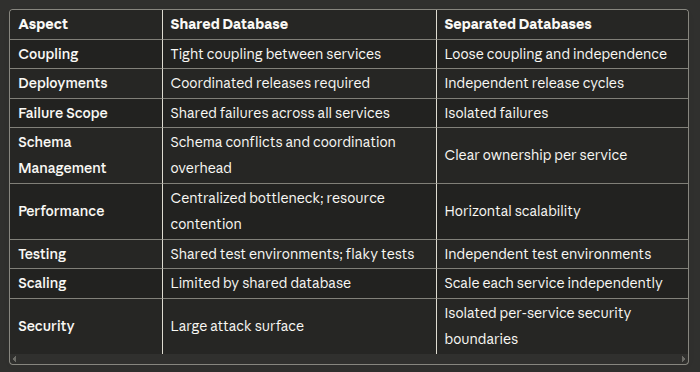
Part 3: Comparison at a Glance
Conclusion
Sharing a database across microservices is an anti-pattern that compromises the independence, scalability, and maintainability that microservices promise. While it may appear to simplify initial setup, it inevitably creates tight coupling, cascading failures, and operational complexity.
The path forward is clear:
- Embrace the database-per-service model as your target architecture.
- Invest in robust inter-service communication using APIs, events, and eventual consistency.
- Treat service boundaries as immutable — data ownership is non-negotiable.
- Execute migrations gradually using proven patterns like CDC and dual writes.
- Enforce governance to prevent regression and schema sharing.
The upfront investment in separation pays dividends: reduced coordination overhead, faster deployments, better scalability, and greater system resilience.
In microservices architecture, autonomy is everything. A shared database takes it away. Make the separation investment now, and your organization will reap the benefits for years to come.