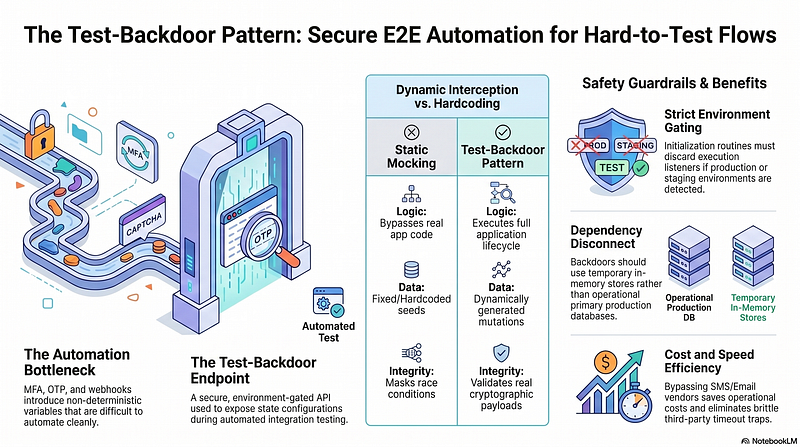
End-to-End (E2E) testing ensures that systems work cohesively from the user interface down to the database. However, modern security architectures — such as Multi-Factor Authentication (MFA), One-Time Passwords (OTP), CAPTCHAs, and third-party webhooks — introduce non-deterministic variables that are notoriously difficult to automate cleanly.
To bridge the gap between high security and test isolation, engineering teams rely on the Test-Backdoor Endpoint Pattern.
A backdoor is a highly secure, environment-gated API endpoint embedded within an application specifically to expose state configurations or bypass hardware-dependent dependencies (like telecom carriers) during automated integration testing.
The Core Strategy: Dynamic Interception vs. Hardcoding
A common anti-pattern in E2E automation is mocking data directly at the testing suite level or using rigid, hardcoded seeds (such as setting an OTP code to always be 123456 in local environments). While simple, this approach masks underlying race conditions, state machine transition flaws, and cryptographic payload delivery issues.
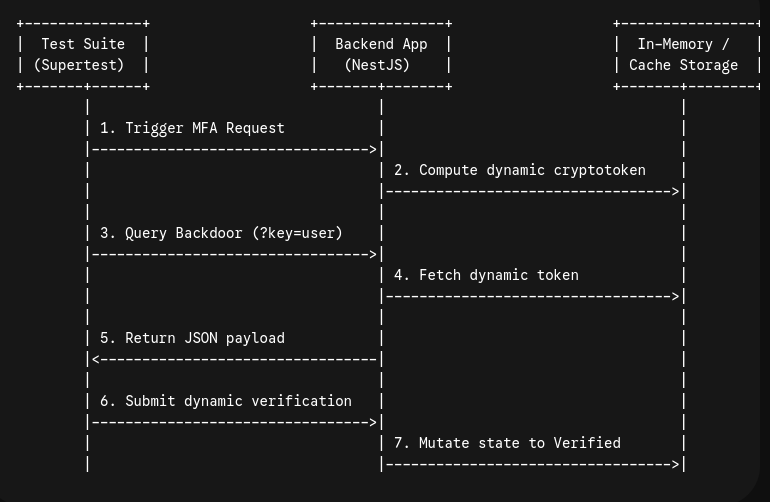
The backdoor endpoint method preserves the real application lifecycle by allowing the backend engine to fully calculate, execute, and store dynamic mutations exactly as it would in production. The test framework then queries the backdoor asynchronously to harvest the dynamically generated token before continuing the assert sequence.
Production Guardrails: Locking Down the Backdoor
Exposing system states via API routes presents extreme risks if deployed improperly. Backdoor vectors must be systematically isolated using multiple strict infrastructure layers to guarantee they cannot be invoked outside controlled validation parameters.
1. Environment Profiling Gating
The endpoint must check structural environment configurations on bootstrap. If the current node environment profile matches staging or production properties, initialization routines should completely discard execution listeners.
2. Dependency Disconnect
Backdoors should rely on temporary, non-persistent structures — such as decoupled localized variables or in-memory stores — rather than operational primary production databases.
Concrete Implementation: NestJS and Vitest
Below is an engineering execution model showcasing an abstracted, safe backdoor implementation inside a NestJS API engine, alongside its programmatic ingestion inside an asynchronous test sequence written with Vitest and Supertest.
1. The Secure Backend Backdoor
This controller establishes the test intercept point. It explicitly requires a valid request key parameter and ensures compilation hooks remain completely unavailable outside local sandboxes.
// test-backdoor.controller.ts
import {
  Controller,
  Get,
  Query,
  NotFoundException,
  ForbiddenException,
} from '@nestjs/common';
import { ConfigService } from '@nestjs/config';
import { TestStateStore } from './test-state.store';

@Controller('auth')
export class TestBackdoorController {
  constructor(
    private readonly configService: ConfigService,
    private readonly stateStore: TestStateStore,
  ) {}

  @Get('last-otp')
  async getLastOtp(@Query('key') key: string) {
    // Enforce strict environment guardrails before processing payloads
    const isLocal = this.configService.get<boolean>('app.isLocal');

    if (!isLocal) {
      throw new ForbiddenException(
        'Test lifecycle endpoints are disabled in this environment.',
      );
    }

    if (!key) {
      throw new NotFoundException('Missing lookup key parameter.');
    }

    const activeToken = await this.stateStore.get(key);
    if (!activeToken) {
      throw new NotFoundException(
        'No active token matches the structural key provided.',
      );
    }

    return {
      ok: true,
      data: { otp: activeToken },
    };
  }
}
2. The Asynchronous Automation Engine
The E2E lifecycle framework handles state variations dynamically by requesting mutations, fetching intercepted metrics via the backdoor payload wrapper, and validating subsequent status state modifications statelessly.
// auth-lifecycle.e2e-spec.ts
import crypto from 'node:crypto';
import request from 'supertest';
import { describe, it, expect } from 'vitest';

const TARGET_HOST = 'http://localhost:3000';

describe('End-to-End Stateful Access Verification Flow', () => {
  // Generate secure, random execution states dynamically per run
  const testReferenceKey = `automation_${crypto.randomBytes(4).toString('hex')}@isolated-domain.test`;
  let interceptedToken = '';

  it('Step 1: Dispatch an operational request to generate a dynamic code', async () => {
    const triggerResponse = await request(TARGET_HOST)
      .post('/api/auth/challenge/generate')
      .set('Content-Type', 'application/json')
      .send({ identityKey: testReferenceKey });

    expect(triggerResponse.status).toBe(200);
  });

  it('Step 2: Access the secure backdoor endpoint to harvest the token', async () => {
    const backdoorResponse = await request(TARGET_HOST)
      .get('/auth/last-otp')
      .query({ key: testReferenceKey })
      .set('Accept', 'application/json');

    expect(backdoorResponse.status).toBe(200);
    expect(backdoorResponse.body.ok).toBe(true);
    expect(backdoorResponse.body.data.otp).toBeDefined();

    // Isolate the volatile dynamic token code safely inside test context execution state
    interceptedToken = backdoorResponse.body.data.otp;
    expect(interceptedToken.length).toBe(6);
  });

  it('Step 3: Submit the harvested token to complete the confirmation handshake', async () => {
    expect(interceptedToken).not.toBe('');

    const verificationResponse = await request(TARGET_HOST)
      .post('/api/auth/challenge/verify')
      .set('Content-Type', 'application/json')
      .send({
        identityKey: testReferenceKey,
        code: interceptedToken,
      });

    expect(verificationResponse.status).toBe(200);
    expect(verificationResponse.body.status).toBe('SUCCESS');
  });
});
Architectural Advantages
- Elimination of Third-Party Costs: Bypassing global SMS gateways, outbound email relays, or notification vendors saves significant operational costs during heavy CI/CD test runs.
- Deterministic Execution Speed: Intercepting internal memory profiles takes milliseconds, avoiding the brittle timeout traps inherent to checking remote email servers or polling third-party delivery queues.
- Flawless Lifecycle Validation: The application executes its real cryptographic computations and validation branches. Only the final external transport medium is swapped, maximizing the integrity of the test coverage.
Visit us at DataDrivenInvestor.com
Subscribe to DDIntel here.
Join our creator ecosystem here.
DDI Official Telegram Channel: https://t.me/+tafUp6ecEys4YjQ1